Can I use copyrighted material in my courses in Australia?

Copyright is a tricky topic with lots of grey areas between “what usually happens” and what’s actually allowed.
Our official stance on using copyrighted material in courses such as VET RTO/TAFE courses or universities is if in doubt, leave it out.
The Education Copyright Licence in Australia
The Education Copyright Licence may allow all staff at an RTO, TAFE, University or similar to copy and communicate copyright works for educational purposes, from any source from anywhere in the world, without having to seek permission prior to use.
Can I embed Youtube (and other hosting service) videos in my e-learning course?
It’s an interesting question and for a simple answer, fall back on the above rule-of-thumb; no.
Searching online however can give you some conflicting information. The thing you will often see is that embedding the Youtube player in your site is nothing more than a hyperlink. Just a link. You are not downloading that video, then uploading it and hosting on your own service.
It turns out that it has even been tested in court (at least in a couple of cases in the US) that linking in this way was not deemed copyright infringement.
According to Youtube’s terms, it appears you may be able to embed a Youtube video in your course, if your course is non-commercial.
The fact that it says “your personal […] use” still makes this a little uncertain.
Erring on the side of caution is better. Most of us would prefer to be providing great learning experiences than testing legal grey areas in lengthy, costly court cases.
Getting permission
Some copyright holders may be happy to give you written permission to use their content.
When it comes to Youtube in particular, they point out the following on their support pages (Links to an external site.):
“If you plan to include copyright-protected material in your video, you’ll generally need to seek permission to do so first. YouTube can’t grant you these rights and we can’t help you find the parties who can grant them to you. You’ll have to research and handle this process on your own or with a lawyer’s help.
For example, YouTube cannot grant you the rights to use content that has already been uploaded to the site. If you wish to use someone else’s YouTube video, you may want to reach out to them directly. Some creators list ways they can be contacted in their channel. Learn more about how to get in touch with others here.”
Free Images
Unsplash.com (Links to an external site.)
All photos published on Unsplash can be used for free. You may use them for commercial and noncommercial purposes. According to Unsplash “You do not need to ask permission from or provide credit to the photographer or Unsplash, although it is appreciated when possible.”
Google Images Labelled for Reuse
Google images has a feature to filter by images that are labelled as having a license for reuse:
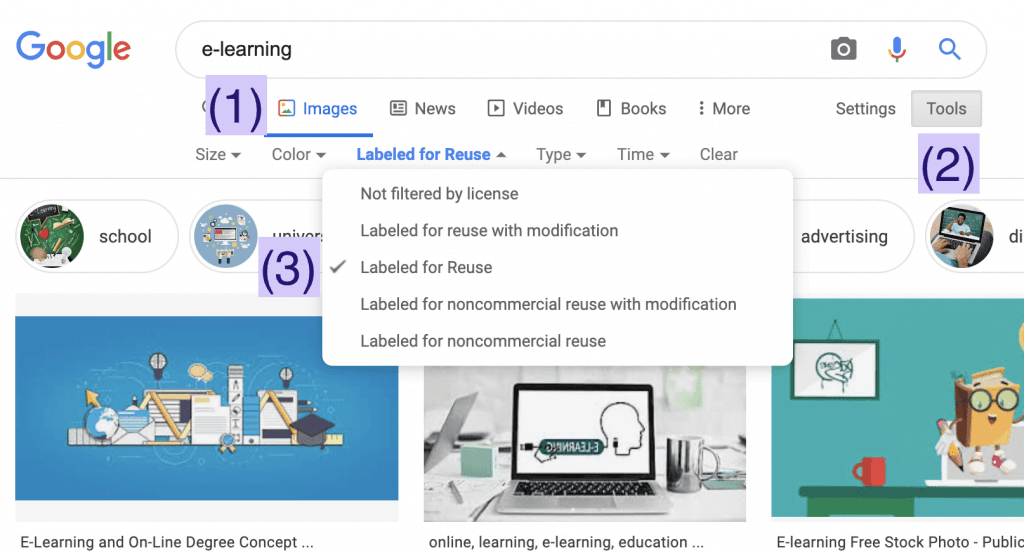
Before reusing Google Images content, make sure that its license is legitimate. Check the exact terms of reuse. For example, the license might require that you give credit to the image creator when you use the image.
Grey areas of copyright
Be aware of the differences between Australian copyright law and overseas law. The US for example has a “fair use” element to their law that Australia does not. In the US, as far as I’m aware, it may be acceptable to use a small portion of copyright material for things like satire and education.
The Australian Copyright Agency’s position on the US’ fair use system is that it is not fair.
Content Generated by Large Language Models (e.g. ChatGPT)
As our digital learning environments evolve, so too does our understanding of copyright. A particularly uncharted area is content generated by Large Language Models such as ChatGPT-4. These tools generate text by synthesising vast amounts of learned information to generate new and unique outputs. Their outputs however, are not necessarily free from copyright obligations. These tools sometimes reproduce or closely mirror copyrighted materials in their responses.
As with any other kind of content, attribution is important when using AI-generated content. The fundamental principles of respecting intellectual property rights remain the same. As responsible users of these powerful tools, we must uphold the same academic, professional, and creative standards that we would for any other source of information or content.
AI-Generated Images
Here we enter a fascinating and complex realm. These tools synthesise images from textual descriptions, merging infinite concepts to form unique visual representations. The usage of these images is not without certain obligations and responsibilities.
It the output closely replicates a pre-existing, copyrighted image, or incorporates significant elements of it, copyright issues may arise. As users of AI-generated content, it’s crucial to ensure that we’re not infringing on anyone’s intellectual property rights, even unintentionally.
The domain of AI-generated content is still in a developing phase. It’s crucial to navigate it with ethical awareness and a commitment to uphold professional and creative standards.
What about as a student of a TAE40122 Certificate IV in Training and Assessment?
As an education institute, Accellier pay an annual fee for a special educational license to use certain amounts of copyrighted material. If you’re a trainer, it is likely that any RTO you work for will do the same.
If you’re a student doing your Cert IV in Training and Assessment, certain units you’re assessed on imply that you should adhere to copyright legal requirements.
This is because you need to demonstrate knowledge of “relevant policies, legal requirements, codes of practice and national standards, including commonwealth and state or territory legislation, that may affect training and assessment in the VET sector.” In short, this includes complying with copyright law.
As most RTOs will hold the education license for copyright, so long as rights, responsibilities, policies, procedures and usage restrictions are confirmed, TAE students are likely to be able to use certain amounts of copyrighted material in presentations and the like.
Again, we remind you of the rule of thumb, “if in doubt, leave it out.”
More info
The Australian Copyright Council has a range of fact sheets and useful Q&A on their website.
Case Studies
Accellier Success Stories
Accellier goes on night-duty to upgrade Steggles/Baiada TAE qualifications
One of the managers John Morriss added that one of the best aspects of the course was the use of real life examples that were relevant to his industry and role.
Baiada PoultryCelebrating the success of the E-Learning Facilitator Micro-credential (TAEDEL501)
Learn more about our TAEDEL501 Facilitate E-Learning Micro-credential.
Accellier Graduate Story: Marion
Marion, a successful Accellier Certificate IV in Training and Assessment graduate tells her story.
Qualified visual arts trainer video