What are “other recognised frameworks” in the TAE40122 units

Introduction
This article explores a strategy for determining the suitability of “other recognised frameworks” as specified in the assessment conditions and performance evidence for some TAE units of competency.
I’ve included a decision-making assessment tool at the end to assist in determining the appropriateness of using ‘other recognised frameworks’ when assessing candidates against TAE units of competency.
VET Context and Background of Certificate IV in Training and Assessment
The TAE40122 Certificate IV in Training and Assessment is highly specific to Australia’s Vocational Education and Training (VET) system. The qualification has always been first and foremost “the certificate you do to become a teacher at a Registered Training Organisation (RTO, e.g. TAFE).”
People using the qualification to be anything other than a trainer/assessor at an RTO will probably find much of the learning experience irrelevant to their situation.
Traditionally, the units of competency in the Certificate IV in Training and Assessment have wording in them that requires the teaching, or assessing, or lesson planning, or whatever the student is doing, to be “based on a training product that is nationally recognised.”
This means if the teaching, assessing, planning, etc, isn’t based on nationally recognised competencies (those found on Training.gov.au) then it cannot be considered valid for the purpose of the assessment.
For most people doing the TAE Certificate IV to become a trainer, this isn’t an issue. The activities in the course are perfectly relevant to how they will use the skills in their VET teaching careers.
It becomes a challenge, most commonly, in these three scenarios:
- Where experienced non-VET educators (such as school teachers, university lecturers, or teachers from overseas institutes) try to get Recognition of Prior Learning (RPL) in the Certificate IV in Training and Assessment.
- Where people or organisations from non-VET contexts enrol themselves or their staff into the course (e.g. corporate learning and development, or industry-specific training).
- Where people or organisations from overseas VET systems look to Australia’s TAE40122 as a valuable trainer/assessor certification.
In the most recent TAE40122 version of the Certificate IV in Training and Assessment, some of the delivery units have been given what appears to be a little opening to broader vocational education teachers.
The wording “or aligned with other recognised frameworks” has been added to what would normally just say something like “must be based on nationally recognised training products.”
The 3 units in the TAE40122 Certificate IV in Training and Assessment which include this allowance for “other recognised frameworks” are:
- TAEDEL411 Facilitate vocational training
- TAEDEL412 Facilitate workplace-based learning
- TAEDEL413 Facilitate distance-based training
The TAE50122 Diploma of Vocational Education and Training also includes similar wording in:
- TAEDEL511 Facilitate e- learning
- TAEDES512 Design and develop print-based learning resources
- TAEDES513 Design and develop e-learning resources
- TAEDEL512 Lead training facilitation
A number of situations, mainly in regards to RPL, have given rise to my investigation into the meaning of “other recognised frameworks.”
The rest of this article details our findings from this investigation and is intended to help Accellier staff (and others who may find it useful) in making sound decisions when assessing TAE units that include this “other recognised frameworks” provision.
What is meant by other recognised frameworks?
My first port of call when exploring the meaning and intention around this was to check the Training Package Companion Volume Implementation Guide. These are intended to provide additional non-endorsed commentary and interpretation around a Training Package and its units of competency however nothing was included in it.
In seeking perspectives from industry specialists and VET practitioners I found varied interpretations though nothing concrete. As an aside, VET practitioners are often cautious when interpreting some of the vaguer aspects of units of competency. This is in part due to fears of their interpretation being inconsistent with that of regulatory officers, and any potential non-compliance actions as a result of that.
All Training Packages have a dedicated Jobs and Skills Council (JSC – formerly Skills Service Organisations or SSO) who develop and maintain them. These are typically organisations to whom you can direct these types of questions.
Unfortunately, TAE doesn’t currently have a JSC. Instead, the Department of Employment and Workplace Relations (DEWR) have temporary oversight of the TAE Training Package while they figure out a longer-term arrangement. In the interim they have a “small time-limited TAE/FSK Training Package Technical Reference Group (TRG)” to assist the department with the TAE and FSK training packages.
I reached out to the TAE TRG via DEWR and received a detailed and thoughtful response, included below for reference (summarised a little for brevity):
The IRC recognised that the Units of Competency identified were not always envisaged to be used by those wishing to deliver nationally recognised training.
Accordingly, the context within the application of the Unit, as well as in the Performance Evidence and specified Assessment Conditions allows for facilitation based on products that are nationally recognised or aligned with other recognised frameworks.
The IRC also maintained a focus on trying not to date the Units of Competency by being too prescriptive and recognised that other frameworks aligned with foundation skills, or for example, micro-credentials could be established in the coming years and the Units of Competency should not limit their use where appropriate.
When assessing what recognised frameworks may be appropriate for use, these may be those recognised Vocational Education & Training (VET) frameworks such as the Australian Core Skills Framework (ACSF), the Digital Literacy Skills Framework (DLSF), or Australian Accredited Courses.
More broadly than these recognised VET frameworks, an individual may also consider well-recognised and robust frameworks such as Australian Maritime Safety Authority standards, Fire Safety Training standards, National Quality Standards (NQS) or Work, Health and Safety standards and frameworks.
We provide these as examples of frameworks which are both widely recognised and sufficiently robust for an individual to facilitate content against as required through the Units of Competency.
Any recognised framework used, where not based on nationally recognised training, would need to be sufficiently detailed for candidates to demonstrate the ability to complete the tasks outlined in the elements, performance criteria and foundation skills specified in the Unit of Competency.
I further enquired if the following be acceptable as “other recognised frameworks:”
- Curricula or learning outcomes from recognised Australian universities
- Competencies and learning outcomes from overseas Vocational Education and Training systems
The response in this regard was that “Curricula or learning outcomes from recognised Australian universities and competencies and learning outcomes from overseas Vocational Education and Training Systems) would need to be assessed against the above in relation to appropriateness for use.”
As a result, I created an “other recognised frameworks” decision-making assessment tool.
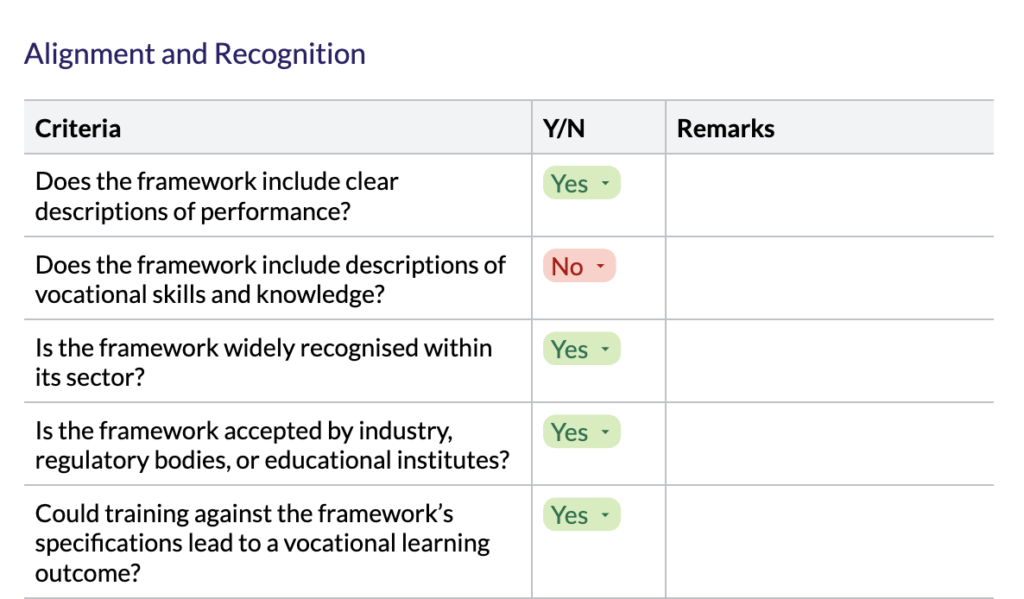
An “other recognised frameworks” decision-making assessment tool
This tool has been developed for the purposes of determining whether another “Recognised Framework” (as distinct from units of competency from Australian Nationally Recognised Training Packages) is suitable for the purposes of assessing competency in TAE units which include wording such as “based on a product that is nationally recognised or aligned with other recognised frameworks” in the Application and/or Performance Evidence section.
It cannot be used to automatically calculate a result, rather, it is intended to be a tool to assist with decision making and rationale and should be retained as evidence to demonstrate that due consideration was given to the suitability of a framework.
The tool is a Google Docs document. To make a copy for yourself in Google Docs that you can edit, simply go to File > Make a copy.
Then you’ll have your own version to edit and use as you see fit.
If you prefer Microsoft Word or other such tools, these can also be easily downloaded by going to File > Download > Microsoft Word (docx) or selecting whatever format you want.
Is this useful? Do you have feedback?
Please share your feedback below.
Case Studies
Accellier Success Stories
Celebrating the success of the E-Learning Facilitator Micro-credential (TAEDEL501)
Learn more about our TAEDEL501 Facilitate E-Learning Micro-credential.
Accellier and the NSW Department of Planning, Industry and Environment
Accellier was approached to assist over 50 highly skilled professionals within the organisation achieve Certificate IV in Training and Assessment.
Department of Planning, Industry and EnvironmentAccellier Graduate Story: Marion
Marion, a successful Accellier Certificate IV in Training and Assessment graduate tells her story.
Qualified visual arts trainer video