Designing Online Courses

Tips for VET Professionals
In our latest Free Professional Development session we delved into the world of e-learning. While many educators could safely ignore e-learning, since 2020, I think we need to appreciate e-learning’s growing significance in the vocational education sphere.
The art of designing engaging and effective online courses can be quite challenging. So in the session we unpacked it in the Australian Vocational Education and Training (VET) context.
While it’s easy to get distracted with the tools and tech of e-learning, it must always have a people-centric focus.
Professional Development Session
In this session we explored some basics of developing online learning in Vocational Education and Training (VET).
WATCH RECORDING
Presentation Slide Deck
Defining E-Learning
E-learning isn’t a new; it has been of our lives for some time now.
To appreciate the breadth and diversity of e-learning methods, consider these two extremes – both considered a form of e-learning. It can be as simple as a PDF document shared on a USB stick. Or on the other end of the spectrum, we have the complex, high-tech world of multimillion-dollar aircraft simulators that deliver immersive, hands-on experiences that closely mimic real-world conditions, helping learners master intricate technical skills in a safe, controlled environment.
An e-learning environment in Vocational Education and Training (VET) is typically made up of Learners, Facilitators, Learning Management System (LMS), Authoring Tools, Facilitation and Communication Tools, Instructional Designers, and the Student Management System.
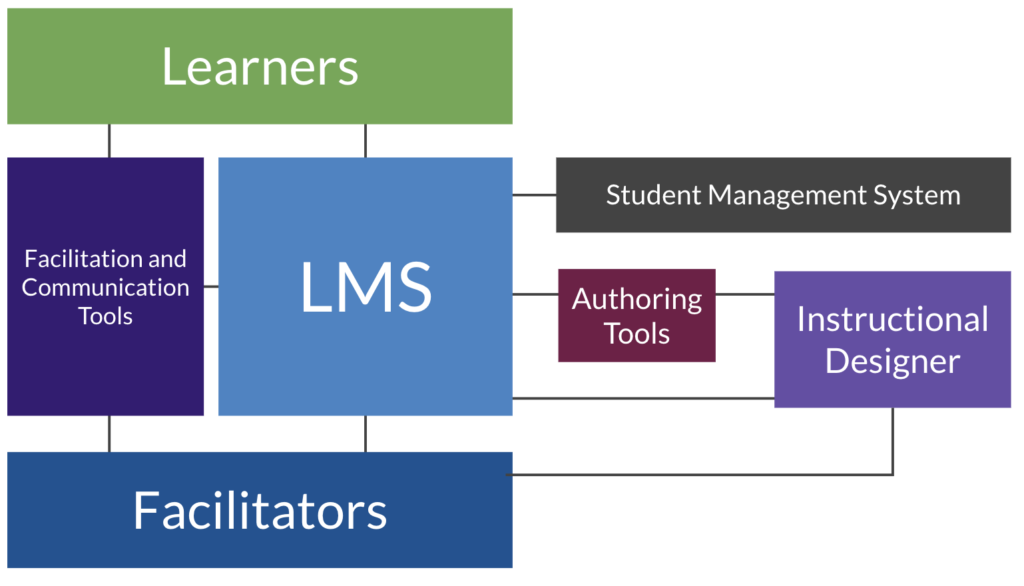
Depending on your role and the size of your organisation, the parts of this image that you work with may vary.
Synchronous and Asynchronous.
Synchronous learning happens in real-time, think webinars or live chats, while Asynchronous learning allows learners to study outside the constraints of time and place, such as videos, PDFs, and discussion boards.
Learning from Our Own Experiences as E-Learners
As educators, we’ve also been e-learners, and our personal experiences can help shape our approach to course design. Let’s face it; there are things we’ve absolutely loved about e-learning, and others we’ve downright loathed.
When we asked participants in our recent session, people said they loved:
- flexibility
- studying at their own pace
- access to course materials for review
- interactive activities
- opportunities for communication with trainers
- clear explanations
- additional support when needed
- and valuable content.
On the other hand, people said they loathed
- boring presentations
- technical glitches
- excessive text
- complex LMS interfaces
- unhelpful feedback on assessments
- disorganised course structure
- lack of clear instructions
- insufficient engagement
- poor support from trainers.
Setting Expectations in an E-Learning Course
Just like in-person teaching, there are ‘protocols’ or rules to be followed in the e-learning space. These include setting clear expectations, communicating effectively, establishing learning objectives, conveying assessment requirements, providing support, and scheduling the learning plan. Moreover, it’s crucial to maintain online safety, protect identities, prevent bullying, discourage discrimination and harassment, respect cultural differences, and ensure privacy.
Designing a Course
When designing an e-learning course, start with three simple questions:
- Who are the learners?
- What are the objectives?
- How will they achieve those objectives?
It’s also essential to incorporate learning science into your course design, such as retrieval practice, spaced practice, and varied practice.
For instance, the Duolingo language learning app effectively employs these practices. It uses retrieval practice through varied activities, spaced practice by gradually increasing the revision periods of previously learned words/grammar, and varied practice by mixing listening, speaking, and translating activities.
Planning Your E-Learning Delivery
Planning is an essential phase in designing e-learning courses. It involves defining the learning objectives, outlining the course content, and creating interactive activities such as experiments, case studies, and videos. Remember to maintain a flow between high skill levels and high challenges, ensuring the learners neither fall into boredom nor experience anxiety.
Here is a free template you can use and adapt for planning your e-learning.
Essential Tech Skills for E-Learning Designers
A savvy e-learning designer should have some basic tech skills, such as HTML knowledge, image and video editing, the ability to learn new software, file management, and basic visual design skills. Assess your areas of strength and improvement considering the Return on Investment (ROI) and what’s best left to others.
Try our questionnaire to help take stock of your E-Learning Design Tech Skills.
Monitor, Review, and Evaluate E-Learning
As the saying goes, “If you don’t measure it, you can’t manage it.” Monitoring, reviewing, and evaluating your e-learning course can provide valuable feedback, measure outcomes, and glean ideas on how to improve your course. You can monitor progress through live sessions, discussions, quizzes, activities, and LMS system reports. Additionally, consider evaluating your course using Kirkpatrick’s 4 levels or Thalheimer’s Learning-Transfer Evaluation Model (LTEM).
Helpful Resources
Copyright in courses
Top 100 Tools for Learning
Design for How People Learn (Book by Julie Dirksen)
The serious E-Learning manifesto
How long should my Zoom/Teams sessions be?
How long should my videos be?
Case Studies
Accellier Success Stories
Accellier and the NSW Department of Planning, Industry and Environment
Accellier was approached to assist over 50 highly skilled professionals within the organisation achieve Certificate IV in Training and Assessment.
Department of Planning, Industry and EnvironmentCelebrating the success of the E-Learning Facilitator Micro-credential (TAEDEL501)
Learn more about our TAEDEL501 Facilitate E-Learning Micro-credential.
Accellier Graduate Story: Marion
Marion, a successful Accellier Certificate IV in Training and Assessment graduate tells her story.
Qualified visual arts trainer video